Your pool is green because the chlorine ran out and algae moved in. That is the answer about nine times out of ten. Free chlorine hits zero, spores that blow into every open pool in Sonoma County finally get a window, and the water turns. It can happen in less than a day.
Before you dump a case of shock in there, though, look at the water one more time. There are two kinds of green and they need opposite treatments. Getting this backwards is how people end up staining their plaster.
First, is it cloudy green or clear green?
Stand at the edge and look straight down at the deep end.
Turbid green
Cloudy. You cannot see the bottom, or the main drain is a vague shadow. This is algae. Shock and an algicide will clear it.
Translucent green
Clear water with a green tint, like looking through a bottle. You can still see the bottom fine. This is usually copper, not algae.
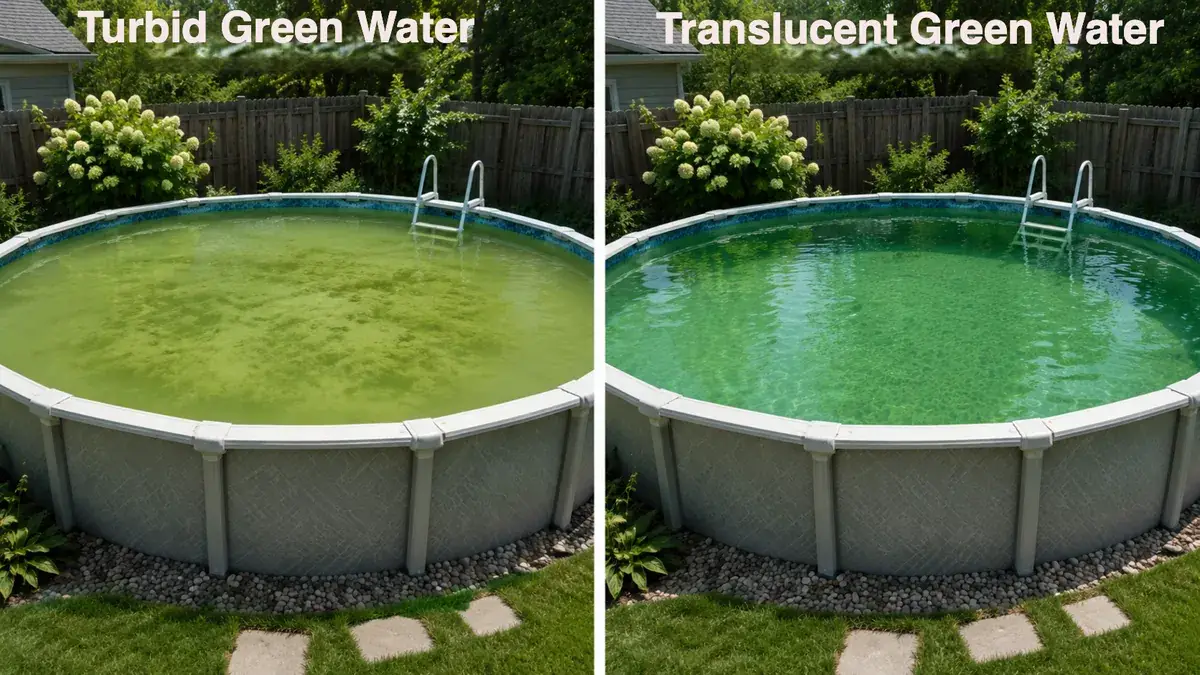
That second one matters more than most people realize. If your green is copper and you shock it, the chlorine reacts with the metal and you can stain the surface. Bumping the alkalinity does the same thing and leaves blue-green marks. So you burn a weekend treating the wrong problem, and now you need an acid wash to fix what the treatment did.
Copper gets into pool water when the pH sits low for a while and starts eating the copper heat exchanger inside your heater. Older homes with copper plumbing add to it. So does well water, which plenty of properties out toward Kenwood and Glen Ellen are running on. A few algicides are copper based as well.
If it is copper, you want a sequestering agent, not shock. Add it, run the filter, retest the next day. Everything below is about the cloudy kind, because that is what most of you are looking at.
Why it went green in the first place
Algae needs three things and your pool hands it all three. Sunlight, warm water, and a gap in the chlorine. The nutrients it feeds on are already in there and always will be, so the only variable you actually control is that last one.
Around here the usual triggers are pretty predictable:
- A hot stretch. When it runs triple digits inland for a week, chlorine burns off faster and the pool needs more than its normal dose. Most people keep dosing the same amount.
- Trees. Valley oak and live oak drop constantly, and redwood needles are worse because they slip past the skimmer basket. If you are under heavy canopy in Bennett Valley, Rincon Valley or Fountaingrove, you are fighting more organic load than someone with an open yard.
- Wildfire ash. Ash pushes pH up and eats free chlorine quickly. Anyone who owned a pool through 2017 or 2020 remembers what that looked like.
- A week away. No brushing, no testing, and a timer that may or may not have run. This is the single most common one I see.
Cyanuric acid deserves its own mention. It is the stabilizer that keeps sunlight from destroying your chlorine, and you want it somewhere around 30 to 50 ppm. The problem is that trichlor pucks add a little more every time they dissolve. Run pucks hard through a hot Santa Rosa summer and the level creeps up. Once it gets too high, your algae risk goes up with it, and the only practical way back down is to drain some water and refill.
Can you swim in a green pool?
No, and probably not for the reason you have read elsewhere.
Algae itself is not generally considered harmful to swimmers. The real problem is that you cannot see the bottom. If somebody goes under in green water, nobody can find them. That is the reason to keep people out, and with kids around it is not a close call.
There are two smaller reasons on top of it. Algae on the deck is slippery, and algae on the pool floor makes it easier to lose your footing at the slope transition and slide into deeper water. Algae can also harbor bacteria, so clear water is worth more than just looking nice.
Once the water is clear again, the question becomes chlorine level rather than color. The CDC recommends a pH of 7.0 to 7.8 and at least 1 ppm of free chlorine, or at least 2 ppm if you are using stabilized chlorine like dichlor or trichlor. In practice most pools run 2 to 4 ppm.
How long after shocking can you swim?
Test, do not time. Anyone giving you a flat number of hours is guessing, because it depends on how much you added, how hot it is, and how much sun the pool gets. Wait until free chlorine comes back down to 4 ppm or below. That is the maximum on EPA-approved product labels and it is the number I would go by.
How to clear a green pool
Assuming it is the cloudy kind, the order matters more than the products do.
- Get the debris out. Skim the surface, empty the baskets, and net whatever is on the bottom. Shock spent on dead leaves is shock wasted.
- Test and fix pH first. Chlorine works poorly at high pH. Bring it into range before you add anything else, or you are throwing money in the water.
- Brush everything. Walls, steps, behind the ladder, the light niche. Brushing breaks up the colonies so the chlorine can actually reach them. This is the step people skip and it is the one that does the most work.
- Shock it properly. Read the label and dose for your actual gallons, not your best guess. Half a dose does not get you half the result. It can get you nothing at all.
- Run the filter continuously. Not on a timer. Continuously, until the water clears.
- Clean the filter as you go. A filter loaded with dead algae stops moving water. Backwash a sand or DE filter when pressure climbs, and expect to pull cartridges more than once. Our page on filter cleaning covers how far to take it.
- Vacuum the dead algae out. It settles as grey dust. Vacuum to waste if your equipment allows, then top the water back up.
How long it takes
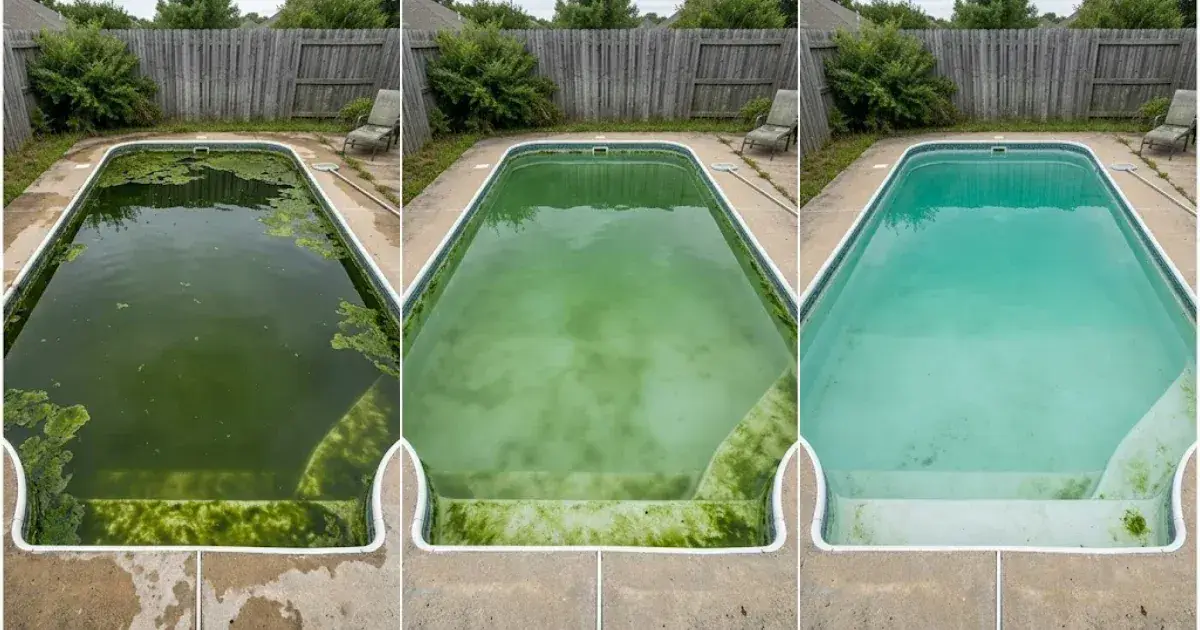
How long a green pool takes to clear
Typical range once treatment starts, with the filter running continuously
Ranges assume working filtration, correct chemistry and continuous circulation. A dirty filter, weak flow or cyanuric acid above 50 ppm can double any of these. A single turnover does not filter the whole pool, so several are needed before the water visibly clears.
Green algae is the most common type and also the easiest to deal with, so most of you are on the lighter end of that chart. Mustard and black algae are the stubborn ones and they usually need a specifically formulated algicide.
Why your pool is still green after shocking it
This is the situation that brings most people to a page like this, and there are four honest explanations.
1. Your test kit is lying to you
This one catches everybody, including people who have owned a pool for years. A standard DPD test kit has two failure modes at high chlorine, and they point in opposite directions.
Push free chlorine up around 10 to 15 ppm and the sample goes faint, or clear, instead of dark. So you look at a colorless vial and read it as zero. Separately, most test blocks only measure up to 5 ppm, so anything above that can read as 5 when the real number is far higher.
Either way you conclude the shock did nothing, and you go add more. Now the pool is way over-chlorinated, it will not clear, and you have spent money making the problem last longer.
The fix is simple once you know. Fill the vial half with pool water and half with distilled water, run the test, then double the result. Use distilled, not tap, because tap water brings its own chlorine and throws the number off. Or use a FAS-DPD titration kit, which does not have this problem at all and is more accurate than a comparator block anyway.
2. You under-dosed
Shock dosing is not a suggestion. If you need to burn off combined chlorine, the free chlorine has to get to roughly ten times your combined chlorine reading. Anything short of that may not get you across the line, and a dose that does not get across the line does almost nothing. Two half doses are not one full dose.
3. The filter cannot keep up
Killing algae and removing algae are two different jobs. Once it is dead it is suspended dust, and it has to physically pass through the filter to leave the pool. If your filter is dirty, undersized, or the flow is weak, the water stays cloudy no matter how good the chemistry looks. Sand that has not been changed in years is a common culprit, which is what our sand change service exists for.
4. You are expecting it too fast
A pool typically turns over its full volume through the filter in about six hours. Here is the part nobody explains: the clean water coming back out of the filter mixes right back in with the dirty water. So one turnover does not filter the whole pool. It takes several before the water is meaningfully clean, which is why a green pool can look completely unchanged the next morning and then clear up fast on day three.
When you can handle it and when to call
I would rather tell you the truth than sell you something you do not need.
Handle it yourself if the water is light green and you can still see the bottom, your equipment runs, and you have a week of evenings. That is a weekend job and some patience. You do not need us.
Call somebody if you cannot see the bottom at all, if it has been sitting for months, if you have shocked it twice with nothing to show for it, if there is black algae dug into the plaster, or if the pump or filter is not working. At that point the chemical bill starts to rival the service call, and a pool that sits green long enough starts staining.
If you are on the fence, our green to clean recovery service page walks through what the process actually involves.
Keeping it from happening again
Preventing algae is far easier than removing it, and it comes down to boring consistency rather than any product.
- Hold a chlorine residual at all times. Every bloom starts with a gap.
- Brush the walls weekly, especially the shaded side and the steps.
- Run the pump long enough in summer to actually turn the water over.
- Test more often when it is hot, not the same amount.
- Watch your cyanuric acid if you run pucks, and drain some water when it climbs.
- Clean the filter on a schedule instead of waiting for a problem.
Most of the green pools we get called out to were not neglected by careless people. They belonged to someone who went out of town during a heat wave. If that keeps happening, weekly service or a chemicals-only plan covers the weeks you are not around.
Common questions
Can over-shocking a pool make it green?
Not exactly, but shocking a pool that already has copper in it causes a related problem. Green or blue-green water is often copper rather than algae. Adding high levels of chlorine to that water drives copper oxide formation, which stains surfaces, so superchlorination is generally not recommended when metals are present. Raising alkalinity leaves blue-green staining for the same reason.
Use a sequestering agent, fix the pH, run the filter and retest after about a day.
Why is my pool still green after shocking it?
Four things cause it, and the most common is that your test kit is misreading the chlorine. The others are under-dosing, a filter that cannot remove the dead algae, and expecting results too fast.
Dilute your sample half and half with distilled water and double the result, or use a FAS-DPD titration kit.
How much shock does a green pool need?
Dose from the product label, calculated on your pool’s actual gallons. Killing algae calls for superchlorination, which just means adding a large quantity of chlorine. There is no universal ppm target, so the label is your number and guessing your volume is how people under-dose.
Breakpoint chlorination is a separate job with a separate calculation. That one is for eliminating combined chlorine, and it needs free chlorine at ten times your combined chlorine reading minus what you already have. A green pool might need both, but they are not the same number.
Can you clear a green pool overnight?
Almost never, and anyone promising it is selling something. Light green with the bottom visible can look much better in about 24 hours. Anything darker takes two to five days, because killing algae and removing it are two separate jobs.
How long does it take to clear a green pool?
About a day for light green, two to three for deep green, four to five for dark green, and a week or more for a swamp. Those assume working filtration, balanced chemistry and continuous circulation. A single turnover does not filter the whole pool, so several are needed before you see a change.
Is it safe to swim in a green pool?
No, though probably not for the reason you have read elsewhere. Algae itself is not generally considered harmful to swimmers. The real danger is that you cannot see the bottom, so if somebody goes under, nobody can find them.
Algae also makes decks and pool floors slippery, and it can harbor bacteria.
How long after shocking can I swim?
Test, do not time. Wait until free chlorine falls to 4 ppm or below, the maximum set on EPA-approved product labels. Depending on the dose, the heat and the sun, that can take a few hours or a couple of days.
Does algaecide actually kill algae?
Yes it does. You will find popular articles claiming algaecide is purely preventative and does not kill algae. That is incorrect. Algicides kill algae, and specific formulations are the recommended treatment for stubborn types like black and mustard.
The confusion comes from the fact that on a full green bloom, chlorine does most of the heavy lifting.
Why does my pool keep turning green when the test strips read fine?
Usually the strips are wrong, your cyanuric acid has crept too high, or chlorine is hitting zero between tests. Strips are convenient but less accurate than a DPD kit, and titration beats both.
Cyanuric acid is the one people miss. Keep it around 30 to 50 ppm. Trichlor pucks push it up over a hot summer, and the only practical way down is draining some water and refilling.
Should I drain my green pool and start over?
Usually not, and it carries a risk most people do not know about. An empty pool can float out of the ground if the water table rises high enough. Never lower water levels where hydrostatic groundwater pressure can damage the structure, which is a real concern here after a wet winter.
Draining makes sense when cyanuric acid is too high to fix otherwise, the water has stood for months, or the surface needs resurfacing anyway.
Green pool in Santa Rosa?
We cover Santa Rosa, Windsor, Rincon Valley, Bennett Valley, Fountaingrove, Oakmont, Kenwood, Glen Ellen and the rest of Sonoma County. Send a photo of the water and we can usually tell you whether it is algae or copper before we come out.
Schedule service · See our service area
(707) 703-4707